“Our lesson on records management has helped me better understand the importance of managing records in the following ways”

CONCEPT OF RECORDS MANAGEMENT

Records management is the area of office management which deals with maintenance of records of organization. It is very important for management for control for records. It is an art of handling and maintaining office records from time of creation to disposal. The records are systematically maintained to preserve for future use. Records management refers to the activities designed to control the life cycle of a record.

IMPORTANCE OF RECORDS MANAGEMENT

1. Preservation of record

It helps in management and control of important records. It helps to protect necessary records with care and disposes useless records.

2. Evaluating progress

It helps in evaluating progress of organization. It helps in preservation of history of organization. The past records shows direction to organization. It helps in finding out the weakness and strength of organization. Record management gives the account of progress and direction in which organization is going on.

3. Facilitate comparison

Record management helps to evaluate business progress and performance. It helps in comparison between one period of time and another or between same times of business

4. Helpful in decision making

Records are the memory of business. It is useful for future decisions making process. The study of past records shows direction for future. It supplies information to organization whenever it is needed. Therefore, it helps in taking decisions.

5. Efficiency in operation

Record management helps to provide required information with speed and accuracy. It helps to make office work efficiently and effectively. It helps to increase efficiency of the office.

6. Evidence

Records acts as an evidence in the time of dispute. It is important for the settlement of dispute. It can be shown as proof in court.

STAGES OF RECORDS MANAGEMENT

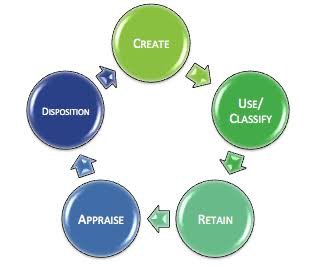
1. Creation of records

It is the first stage of record management. It is the most important stage. In this stage records are either created inside the organization or are received from outside the organization in form of letters or notices.

2. Storage of records

It is the second step of record management. Once records are created they must be retained or protected. This stage is also known as retention of records. It is the preservation of records for future reference. The records are recorded in such a way so that it can be easily located in the required time.

3. Use of records

It is the third stage of record management. In this step the stored records in the past are used for planning, organized, deciding, and preparation of accounts and so on.

4. Disposal of records

It is the fourth and last stage of record management. Records cannot be stored forever. Outdated records must be destroyed or disposed.

Records Management Illustration:
Hope our lessons help you to be more organize and have discipline to your personal records.

THANK YOU AND GOD BLESS!

“Getting organized is easy, Staying organized requires discipline” – Lourie Palau

5 Good Habits That Will Improve Your Life


At times it can feel like life is bad on all fronts: you work is stagnant, you personal life is unsuccessful and your personal health, physical and mental, has been neglected. You are not achieving your goals or fulfilling your potential, and you are unhappy as a result. First, know this happens to everyone- you are not alone. Also know that this does not have to be your life, you can change it. You can better yourself. It will take a lot of work, a lot of courage and a lot of grit, but if you keep going and believe in yourself you are going to achieve your goals and be the best version of yourself.

Here are some good habits to improve your life in the new year, that will help you reach your goals when it becomes hard to continue:

1. Stop Sacrificing What You Want Most For What You Want Right Now

It would be lovely to relax, watch a movie or a show, meet a friend for dinner, etc. instead of working longer on a project that needs attention, going to the gym, making dinner at home, etc. Instant gratification is seductive and satisfying, but not when it is at the expense of long term goals, especially goals that will help build your self-esteem and help make progress towards your goals. Stop sacrificing substantive happiness, that will bring you consistent and lasting joy for superficial, momentary happiness, which will fade quickly and ultimately extend unhappiness.

2. Stop Making Excuses

If you are looking for a reason/excuse not to do the right thing, you will surely find one. Part of taking ownership of your life and reflecting on how you got to an unhappy state is understanding how you are enabling your poor decisions. It is usually with excuses, like you’re tired, or you don’t have time when you’re not making time, you will do it tomorrow, etc. Stop making excuses, and start owning your life and pushing yourself to do the work. Happiness doesn’t fall into your lap, it takes work like everything else. So get out of your own way and stop making excuses.

3. Eliminate Distractions

If you find yourself wasting a lot of time staring at various screens, constantly checking social media or mindlessly doing things on your phone, start trying to monitor those habits and change them. Whatever your go-to distraction is, start managing it so you can be more productive and stop wasting time.

4. Face Fear

Any wildly successful person has failed, sometimes on a massive, humbling scale. No one who is successful will ever judge you for failing, so start summoning your courage and stop being afraid to work hard and fail. The only people who will ever judge you are people who have not failed themselves, usually because they’ve made incredibly safe choices. So face your fears, stop being afraid of failure and do the work. Doing the work is how you gather courage and begin making progress towards becoming your best self.

5. Stop Playing The Victim

You are not a victim of every whim and circumstance, you do have some control over your life at any given time. It is about how you wield that control that determines whether you change your circumstances. Stop resisting responsibility for your life, because the sooner you take ownership of it and stop blaming others, you will have more autonomy, you will start doing the work therefore you will begin making progress.

Hope this 5 habits can help for you to have a better life.

Good Day!

An interview with Associate Senior Manager

“Teamwork is the ability to work together toward a common vision. The ability to direct individual accomplishments toward organizational objectives. It is the fuel that allows common people to attain uncommon results.”

–Andrew Carnegie

I interviewed Mr. Raymart De Jesus as an associate senior

manager in BPO industry located at Quezon City. Through internet we communicate each other.

The following questions I interviewed are:

1. What was your role, duties and responsibilities?

I worked as an associate senior manager for BPO industry firm from 2018 up to present. It was my job to make sure all project guidelines in every team leaders were followed and that work load were being met. It was also my responsibility to communicate directly with the senior manager, team leaders and almost 3,000 members. When project guidelines were missed or ignored, or project phases didn’t meet specs, I communicated my findings to the team leaders who in turn took the necessary action to fix the problems.

2. How did you contribute to this task group?

For about one year I worked with a project manager who felt that project guidelines were too strict. Consequently, he was reluctant to enforce guidelines and reprimand other team members when work was performed outside of guidelines. I had to walk a fine line between maintaining the peace and doing my job. On one specific occassion, where there was a blantant violation of protocol, I took it upon myself to communicate my findings directly to the senior manager. With his permission I also communicated directly with several team members to remedy the situation.

3. How often did you interact with other team members?

When the team leader caught wind of what I had done, he was pretty upset–and that’s putting it mildly. He pulled me into his office and immediately confronted me about superceding his authority. I was direct and honest in my response to his affront. I let him know that I felt he was one of the best team leaders I had worked with but he had a tendency to ignore important quality assurance guidelines. I also told him that I was only there to do my job and that as long as he saw fit to have me on his team I would continue to my job to the best of my ability, even if he didn’t feel my role was necessary. To my surprise he apologized and told me he appreciated my candor and integrity. He did admit he didn’t see the necessity of my position but that as long as it was required by corporate he would respect it.

Jeremiah 29:11
“For I know the plans I have for you, plans to prosper you and not to harm you, plans to give you hope and a future”